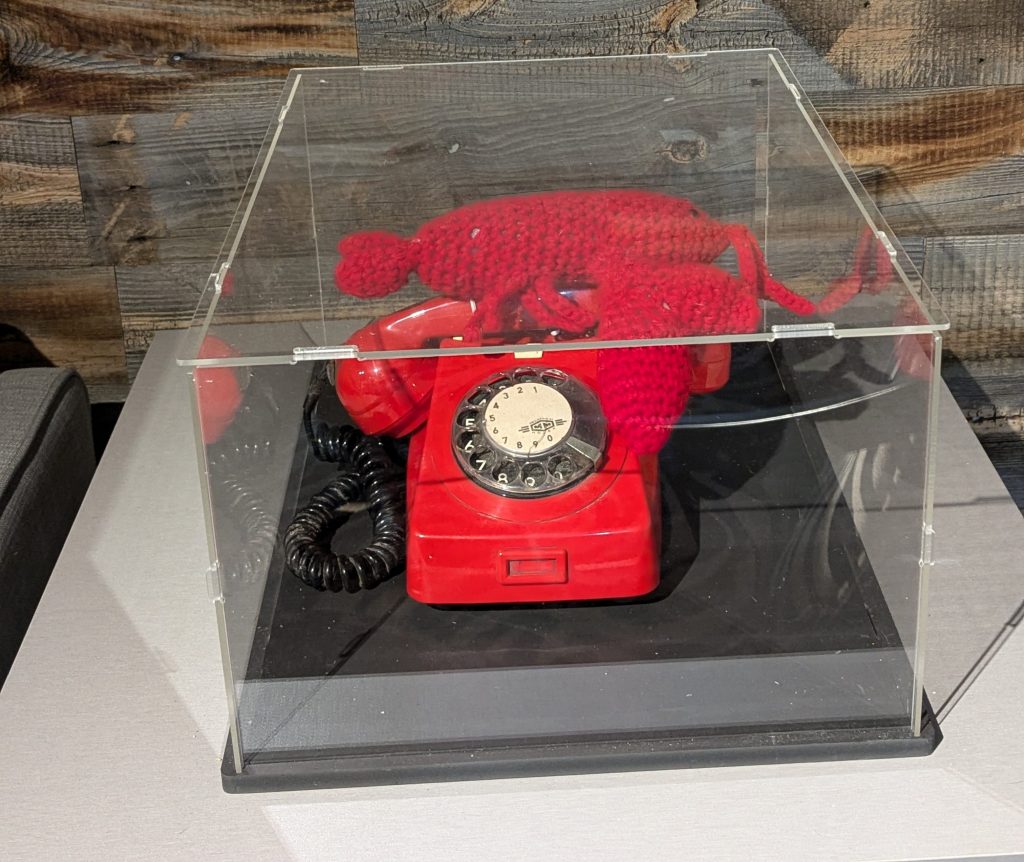
Lobster telephone
Artist: Susan Davis
The postscript I imagine in the museum of the future: Polyester yarn, toxic white stuffing, Bakelite, water-based glue, ear wax, hairspray. 36 x 12 x 15 cm [I can dream that the US will finally get its shit together on metric]This previously undisplayed masterpiece was found in the basement of the artist next to her decaying and partially eaten body. She died after falling down the stairs. Before she was discovered 30 minutes later, her dog had gotten a little desperate. According to the author’s scribbled notes, this surrealist object was inspired by Dali.
“Lobster telephone, by Dali,” read the tasteful cream-colored card next to this bizarre objet d’art. The exhibit was an old school black rotary telephone with a plastic red lobster sitting on top of it. My New York friends and I were wandering through a surrealism exhibit at the Met, mostly making fun of things. We might have had a few drinks at the rooftop bar.
I waved them over and demanded, “How is this art? Anyone could make this!” Someone said anytime you think “I could do that” after looking at some simple-looking piece of art, just remember “You could have, but you didn’t.”
Even after our visit, I was obsessed by this artwork. Was it art because it was innovative? Was it sticking with me because it was bizarre? Did Dali start with making a prototype of the cell phone and everyone said it was boring?
The art world has a love/hate relationship with things that are out of the ordinary. Just like the international development world. We crave something different because we know that the same old same old isn’t achieving what we’d hoped. This makes us susceptible to anything that is eye-catching, like the colorful Play Pump, or magical, like the Slingshot.
This image of a shellfish encrusted communication device clung to my brain like a barnacle. My research turned up a surprising fact: Dali thought lobsters were aphrodisiacs. The only time I’ve considered a lobster sexy was after watching that scene in Splash where Darryl Hannah’s mer-maid turned hu-maid bit into one. She was on a fancy date with Tom Hanks, and he didn’t leave! (It gave me hope as an awkward pre-teen)
A year or two later, wandering through an eclectic flea market in a shaded alley in Budapest to escape the summer sun, I fell in love with a dusty communist-red telephone.
The vendor’s table, covered with a red-checked tablecloth, featured a variety of charming Soviet-era household items. My telephone – for I knew immediately that, despite its weight, I would buy it and carry around the rest of the day as I walked around the city – my telephone was the kind with a sturdy body, a rotary dial, and a handle – the embodiment of the classic telephone icon. The kind you could hang up with a satisfactory bang. I picked it up and chirped “Helloooo?” to the non-amusement of the vendor.
A grayish film hid the splendor of my object of desire. It smelled of coal dust and nuclear fallout. The earpieces of the handset had traces of everlasting hairspray and a smidgen of ear wax from intense listening to whispered secrets. The holes in the rotary dial retained the lingering scent of anxious perspiration from urgent calls seeking help for a child’s high fever. It had a long black fabric-covered cord with a weird three-pronged plug. I had no hope of ever using it for its intended purpose. I paid 10,000 Hungarian Forints (about 30 US dollars) for it. “What?! Too much!” exclaimed my Hungarian friends. “We have five of those at our parents’ house.”
I dragged that heavy, dirty thing in my suitcase back to Virginia.
In one of my manic creativity phases, I decided I had to make it into “art.” I searched Amazon for a realistic lobster topper. Dali made a few lobster telephones, including some with whitish crustaceans. That gave me some freedom for creativity.
I toyed with the idea of using some other seafood, like a “Tentacle Telephone” with a squid. Has a nice ring to it. Then I moved to Etsy. My artistic principles demanded an ethically sourced lobster, not something mass manufactured. After a few wine-fueled hours of searching, I decided on a five-inch long red crocheted and stuffed lobster. It was almost a perfect match for the now cleaned up and shiny paprika red telephone. I was so eager to unite the pair that I almost paid for shipping. Remembering starving artist mode, I chose the free shipping option. Absence makes the heart grow lobster.
As I write I’m realizing that sticking with the red color of the lobster implies it has been boiled, which recent research is showing they can feel. Where is the research on how telephones feel when they are boiled?
When the adorable soft lobster arrived, I plunked it unceremoniously on top of the telephone. It was an unsatisfying coupling, as romances that start from a long distance often end up. Friends who came over barely noticed it.
A few months later, I realized that to be considered art, it needed a display case. I bought the cheapest plexiglass case I could find – intended to house a completed Lego creation or a model car. My artwork still awaits a plaque. I like to think it will get one after my death when an eager museum snatches up my papers and oeuvre.
In June 2024, I visited the Dali Museum in Figueres, Spain. Dali made many more bizarre and much larger sculptures that would require more dedication for me to replicate. I am grateful that the sheer impracticability of making my own Rainy Taxi (aka Mannequin Rotting in a Taxi Cab) – replete with interior irrigation, mannequins, lettuce, and live snails – did not quash my brief surrealist phase.
Dali was undeniably innovative. It’s fun to guess what inspired each work. Maybe he saw something in a museum and asked “How is this art?”
 Susan Davis
Leave a comment