Let’s not make the same mistakes
Sustainable Development Goal (SDG) 6, target 6.2 is to END OPEN DEFECATION AND PROVIDE ACCESS TO SANITATION AND HYGIENE: By 2030, achieve access to adequate and equitable sanitation and hygiene for all and end open defecation, paying special attention to the needs of women and girls and those in vulnerable situations. Billions have been spent on sanitation over the past few decades, yet we still have a long way to go. As of 2022, 3.5 billion people (42% of the world’s population) lacked safely managed sanitation services, and 419 million people practiced open defecation. It’s critical that we don’t make the same mistakes as we have in the past.
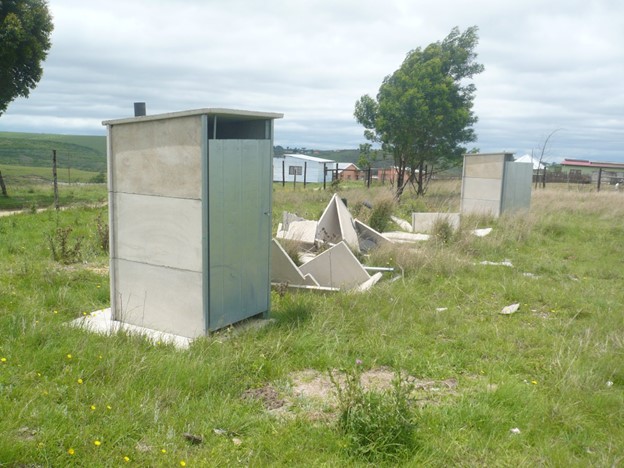
Collapsed latrines
Asia
Afghanistan
- 54% of 13,458 toilets in public schools needed extensive repair or replacement (WASH for School Children, UNICEF, 2012).
Bangladesh
- Nationally, 56% of the toilets in public schools need extensive repairs. While 42% of schools report providing soap for handwashing, soap was found in only 17% of schools (WASH for School Children, UNICEF, 2012).
- In 2010 World Bank study, 89.5% of sample households owned or shared a latrine that safely confined feces, but only 44% of those were clean (Hanchett et al, 2011).
Bhutan
- Nationally, only 60% of the boys’ toilets, 70% of the girls’ toilets and 70% of the water supply schemes in public schools are functional (WASH for School Children, UNICEF, 2012).
Cambodia
- In areas where community-led total sanitation (CLTS) methods were used to promote latrine use, only about 15% of households with a latrine use the toilet regularly, while the rest keep going to the bush for defecation (WSP, 2012).
- In two communities where an NGO had provided free latrines (not requiring any cost–sharing by households), one third (33%) of all the latrines observed were broken up and abandoned, just three years after construction (Mukherjee, 2001).
China
- World’s biggest eco-toilet scheme fails
India
- In Bihar, a common practice once the pit was full was to revert to the practice of open defecation. The percentage of the population going back to open defecation was close to 90% (an educated guess as there is no monitoring of latrine usage) (Tremolet & Binder, 2013).
- The Total Sanitation Campaign was intended to be a community-led, people-centered, demand-driven and incentive-based program to address India’s rural sanitation crisis. But outcomes were remarkably poor. 2011 census data showed 31% sanitation coverage, far from the 68% reported by the Government. “The decade has witnessed progress slowing down and the number of rural households without latrines increasing by 8.3 million.” (Hueso & Bell, 2013)
- Analysis of data from 14,591 schools shows 8.4% of schools have no toilet facility, and 35.1% of schools have facilities but the toilet is not useable (ASER Centre, 2012).
- Although 90% of schools had toilets, 50% of schools had nonfunctional toilets. This was a decline from 2007 when 25% of school toilets were found nonfunctional (WASH for School Children, UNICEF, 2012).
- 6% of schools have toilets and 89% have urinals; however, in 20% of schools the toilets are not functioning. (UNICEF, 2010).
- An estimated 50% of subsidized toilets remain unused or are being used for purposes other than sanitation (WSP, 2007).
Maldives
- In public schools across the country, 27% of the toilets need extensive repair or replacement (WASH for School Children, UNICEF, 2012)..
Nepal
- A study of Community-led Total Sanitation (CLTS) effectiveness showed while all but one of the communities studied had achieved open-defecation free (ODF) status, there was evidence of fairly widespread non-compliance in the form of now-hidden open defecation (WaterAid 2009).
- In the 1980s four wastewater treatment plants were built in Kathmandu Valley, but they are still not functioning well because of poor operation and maintenance (Tuladhar, B., Shrestha, P., Shrestha, R., 2008)
Pakistan
- In public schools nationally, 43% of the toilets need extensive repair or replacement (WASH for School Children, UNICEF, 2012).
South America
Peru
- In Loreto Region, it is estimated that 85% of latrines are considered unusable (Calderon, J., 2004. Agua y saneamiento
Sub-Saharan Africa
Ethiopia
- Of the 11 communities that were confirmed [open defecation free (ODF)] previously, only four were currently ODF (a slippage rate of 63%) (TetraTech, 2015).
Ethiopia, Kenya, Sierra Leone, Uganda
- In a study commissioned by Plan, nearly 5000 households in 116 villages were re-assessed according to the original open defecation free (ODF) verification criteria. If all five criteria below are applied, the overall slippage rate across the study was 92%. In all countries each household was expected to have: A functioning latrine with a superstructure/ A means of keeping flies from the pit/ Absence of excreta in the vicinity of the house/ Hand washing facilities with water and soap or soap-substitute such as ash/ Evidence that the latrine and hand washing facilities were being used (FH Designs, 2013)
Ghana
- In a study in rural areas, 60% of new latrines (0-2 years) are being used (Rodgers, 2007).
Madagascar
- Post implementation monitoring showed that 59% of Malagasy homes do not use latrines, and 67% of households lack handwashing facilities. (WaterAid, 2015).
- Only 43% of villages that had been declared ODF are now considered by the community as ODF, while only 25% of all villages were ODF at the time of the survey [75% failure] (UNICEF & WaterAid, 2014).
- An Open Defecation Free (ODF) verification survey of 1,829 villages declared ODF found slippage of 21% (377 villages) (WSSCC, 2014).
Malawi
- Post implementation monitoring showed that 8% of homes do not use latrines, and 8% of households lack handwashing facilities. (WaterAid, 2015).
- Sanitation nonfunctionality rates are around 37% (WaterAid, 2010).
South Africa
- An informal survey of toilets at schools that fall within four of the National Health Insurance pilot districts found that at all 17 schools the toilets were in a shocking condition (AllAfrica, 2013).
Zambia
- Two children died after a pit latrine they were in collapsed. Rains and flooding have weakened infrastructure, making latrines prone to collapse (Zambian Eye, 2021).
- Post implementation monitoring showed that 85% of homes do not use latrines, and 38% of households lack handwashing facilities (WaterAid, 2015).
West Africa
Côte d’Ivoire
- In 1994 the African Development Bank financed a sewage treatment plant in Daloa to treat wastewater from the regional hospital complex. A follow-up review in 2002 (Maiga et al, 2002) noted that the plant was no longer operational. It had been left to fall into disuse and vegetation had invaded and covered the ruins of its basins and dams. (UNEP, 2015)
 Susan Davis
Leave a comment